Live and Work in Texas 2026: Houston, Dallas, Austin and San Antonio Jobs, Pay and Rent
Moving to Texas for work? Compare Houston, Dallas, Austin and San Antonio wages, rent, taxes, visa routes and real costs like cars, heat and health insurance.
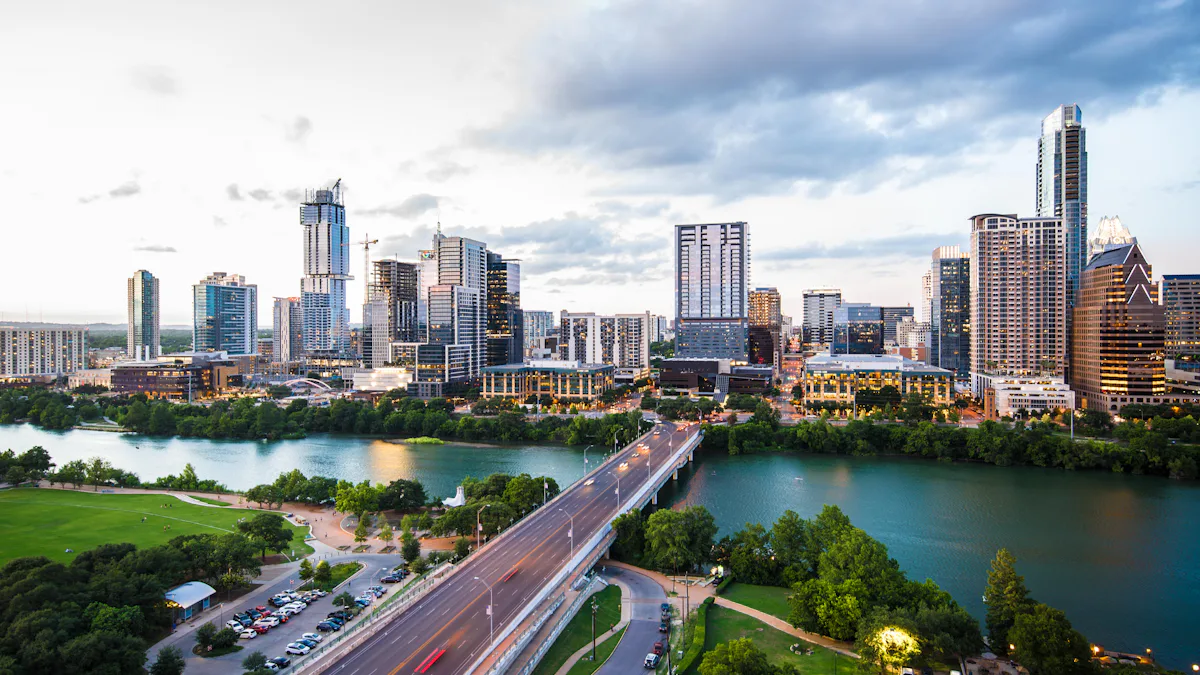
Texas takes no state income tax out of your paycheck. For a nurse earning $90,000 in Houston, that can mean several thousand dollars a year more than the same job pays after tax in New York or California. Add rents that are still lower than on either coast, and it's easy to see why so many newcomers end up in Texas.
The state is huge, with more than 31 million people, and roughly one in six residents was born abroad. Houston, Dallas-Fort Worth, Austin and San Antonio each have very different job markets and price tags. Pick the wrong city for your field and you will feel it.
This guide compares the four big metros on pay, rent and jobs, explains how Texas taxes actually work, lists the visa routes people use to get here, and covers the costs that surprise newcomers: cars, summer power bills and health insurance.
In this guide
- Texas at a Glance
- Why People Move to Texas, and the Trade-offs
- The Big Four Cities Compared
- Wages by City and Field
- Cost of Living and Rent
- How Texas Taxes Work
- Visa Routes Into Texas Jobs
- Settling In: First Steps After Arrival
- The Legal Climate for Immigrants in Texas
- Common Mistakes Newcomers Make
- Frequently Asked Questions
- Before You Move
Texas at a Glance
| Item | Details |
|---|---|
| Population | More than 31 million (Census Bureau estimates) |
| State income tax | None on wages |
| Sales tax | 6.25% state rate, up to 8.25% with local taxes |
| Average pay, all jobs | BLS mean $29.39/hour (San Antonio) to $35.85/hour (Austin), May 2025; US mean $33.54 |
| Typical 1-bedroom rent | Roughly $1,000 to $1,700 a month depending on city and area |
| Main visa routes | H-1B, EB-3, TN, L-1, H-2B, F-1 with OPT |
| Biggest hidden costs | Car ownership, property taxes built into rent, summer electricity, health insurance |
| Official sources | BLS, Texas Comptroller, Texas DPS |
Why People Move to Texas, and the Trade-offs
What's good:
- No state income tax on wages
- Large, varied job markets in energy, healthcare, tech, logistics, construction and finance
- Housing that is cheaper than most coastal metros
- Big immigrant communities, including large Nigerian, Indian, Pakistani, Vietnamese, Filipino and Latin American populations in Houston and Dallas
What's hard:
- Car dependence. Outside a few central neighborhoods, you need a car to work and shop.
- Heat and storms. Summers regularly pass 38°C (100°F), and Houston sits in a hurricane zone with flood risk.
- Property taxes. Texas makes up for no income tax with some of the highest property taxes in the country. Landlords pass them on in rent.
- Health coverage. Texas has the highest share of uninsured residents of any state, according to Census Bureau surveys, and it has not expanded Medicaid. A job with health insurance matters more here.
The Big Four Cities Compared
Houston
Houston is the US energy capital and home to the Texas Medical Center, one of the largest medical complexes in the world. Oil and gas, petrochemicals, the port, engineering and healthcare drive hiring. It is also one of the most diverse cities in the country.
Pay is close to the national average (BLS mean $32.51 an hour in May 2025), and rents are moderate by big-city standards. Southwest Houston, Alief and Sugar Land have well-established African, South Asian and Asian communities. Check flood maps before you sign a lease.
Dallas-Fort Worth
DFW is a sprawling metro of more than 8 million people with corporate headquarters, banking, insurance, logistics and a large tech sector. Average pay is slightly above the national mean ($33.96 an hour). Plano, Irving, Richardson and Frisco have big Indian and Asian communities and many tech employers. Commutes can be long.
Austin
Austin has the highest average pay of the four ($35.85 an hour) thanks to tech, semiconductors and the state government. Rents rose sharply after 2020 and then eased as thousands of new apartments opened, so 2026 renters have more choice than a few years ago. Competition for tech roles is fierce, and entry-level jobs outside tech pay less than the headline average suggests.
San Antonio
San Antonio is the cheapest of the four, with the lowest pay ($29.39 an hour). Military bases, healthcare, insurance, tourism and manufacturing dominate. It suits people who value lower rent over higher salaries, and it has a large Mexican-American population, so Spanish is widely spoken.
Wages by City and Field
These are mean hourly wages from the BLS Occupational Employment and Wage Statistics survey for May 2025.
| Occupational group | Houston | Dallas-Fort Worth | Austin | San Antonio | US |
|---|---|---|---|---|---|
| All occupations | $32.51 | $33.96 | $35.85 | $29.39 | $33.54 |
| Healthcare practitioners | $50.30 | $52.34 | $48.95 | $47.00 | $52.26 |
| Computer and mathematical | $52.79 | $57.55 | $58.73 | $50.81 | $57.73 |
| Business and financial | $44.04 | $44.39 | $44.76 | $41.06 | $45.78 |
| Construction and extraction | $27.41 | $27.03 | $27.53 | $25.94 | $31.42 |
| Transportation and moving | $24.26 | $24.17 | $21.90 | $21.23 | $23.96 |
| Food preparation and serving | $14.70 | $15.74 | $16.50 | $15.02 | $17.86 |
Notice that construction pays below the national average in all four cities, and food service pays well below it. Texas's minimum wage is the federal $7.25, although most employers in big cities pay well above that.
Cost of Living and Rent
Rents change month to month, so use these as rough 2026 ranges for a one-bedroom apartment in an ordinary neighborhood, then check current listings.
| City | Typical 1-bedroom rent (USD/month, approx.) | What pushes it up or down |
|---|---|---|
| Houston | $1,050 to $1,450 | Cheaper in Alief and the outer suburbs; pricier inside the Loop |
| Dallas-Fort Worth | $1,200 to $1,650 | Uptown and Frisco cost more; Fort Worth and Arlington less |
| Austin | $1,250 to $1,700 | New supply has kept rents flat; central areas remain expensive |
| San Antonio | $950 to $1,300 | Lowest of the four; north side costs more |
Other monthly costs to budget for:
- Car: loan or purchase, insurance (often $150 to $250+ a month for new arrivals without US driving history), fuel and registration
- Electricity: summer bills of $150 to $300+ for an apartment are common because of air conditioning
- Health insurance: if your employer doesn't cover it, marketplace plans can cost hundreds of dollars a month before subsidies
- Deposits: without a US credit history, landlords often ask for a larger deposit or a co-signer
How Texas Taxes Work
Texas has no personal income tax. You still pay federal income tax and Social Security and Medicare (FICA), just like anywhere in the US.
The state collects money in other ways:
- Sales tax: 6.25% state rate plus local taxes up to 2%, for a maximum of 8.25%. Most unprepared groceries are exempt. See the Texas Comptroller's sales tax page for local rates.
- Property tax: paid by owners, and passed on to renters. If you buy a home, expect annual bills of roughly 1.5% to 2.5% of value depending on the area, before exemptions.
- Vehicle fees: registration and a 6.25% motor vehicle sales tax when you buy a car.
Visa Routes Into Texas Jobs
Texas employers use the same federal visa programs as everywhere else. The ones most relevant to newcomers:
- H-1B for degree-level jobs in tech, engineering, energy and healthcare. See our H-1B lottery and fees guide.
- EB-3 green card sponsorship, common for nurses and some skilled and "other worker" jobs. See our EB-3 sponsorship guide and our guide to nursing jobs in the USA.
- TN for Canadian and Mexican professionals; Texas's ties with Mexico make this common.
- L-1 for employees of multinationals moving to a Texas office.
- H-2B for seasonal construction, landscaping and hospitality work.
- F-1 student visa with OPT at Texas universities such as the University of Texas at Austin, Texas A&M, the University of Houston and UT Dallas.
Settling In: First Steps After Arrival
- Get your Social Security number if you are authorized to work.
- Open a bank account. Bring your passport, visa, I-94 and proof of address.
- Get a Texas driver's license. New residents with an out-of-state or foreign license generally must get a Texas license within 90 days. Texas requires proof of lawful presence. Check requirements on the Texas Department of Public Safety site.
- Build credit. A secured credit card, paid in full each month, is the usual starting point.
- Sort out health insurance through your employer, or the federal marketplace if you qualify.
- Find your community. Houston and Dallas have churches, mosques, temples and associations for most diaspora groups, which can help with housing tips and job leads.
The Legal Climate for Immigrants in Texas
Texas takes an active approach to immigration enforcement. Some state laws are in effect, and others have been tied up in federal courts. A few points newcomers should know:
- Keep copies of your passport, visa, I-94 and work authorization with you or easily accessible.
- A 2025 state law restricts some property purchases by people connected to certain countries, including China, Iran, North Korea and Russia, with exceptions for US citizens and permanent residents. Get legal advice before buying land if this could apply to you.
- Undocumented students lost in-state tuition eligibility in 2025.
If you are in lawful status, day-to-day life is little different from other states. If anything about your status is uncertain, speak to a licensed immigration attorney before moving.
Common Mistakes Newcomers Make
- Taking a job in a far suburb without a car plan
- Signing a lease in a flood-prone area without checking flood history
- Ignoring health insurance because the job pays well
- Comparing gross salaries across states without factoring in rent and taxes
- Driving on a foreign license past the allowed period
Frequently Asked Questions
Does Texas really have no income tax?
Yes. Texas does not tax wages or personal income at the state level. You still pay federal income tax and FICA, and the state relies on sales and property taxes instead.
Which Texas city is best for immigrants?
It depends on your field. Houston suits energy, engineering and healthcare workers and has huge diaspora communities. Dallas is strong for corporate, finance and tech jobs, Austin pays the most for tech, and San Antonio is cheapest.
How much do I need to earn to live comfortably in Texas?
A single person can usually manage on $45,000 to $55,000 a year in San Antonio or outer Houston, more in Austin or central Dallas. A family with children and one car payment should budget well above that. Rent should ideally be under a third of take-home pay.
Do I need a car in Texas?
In almost all cases, yes. Public transport exists in all four big cities, but it covers only part of each metro. Budget for a car, insurance and fuel from the start.
Can I use my foreign driver's license in Texas?
Visitors can often drive on a valid foreign license for a limited time. New residents are expected to get a Texas license, generally within 90 days. Rules vary by your status, so check with Texas DPS.
Is Texas a good place for nurses from abroad?
Texas has large hospital systems and steady demand for nurses, and Houston's medical center is one of the largest in the world. Texas is part of the Nurse Licensure Compact for US-licensed nurses. Foreign-educated nurses still need the NCLEX and usually EB-3 sponsorship.
Before You Move
- Pick the metro that matches your field, then research neighborhoods by commute time and flood risk.
- Compare offers on take-home pay after rent, car and insurance.
- Confirm your visa route and that your employer's offer includes health insurance.
- Check current wage data in the BLS Houston area release and similar releases for other metros.
Disclaimer: This guide is general information, not legal or immigration advice. Fees, quotas and requirements change often, so confirm every detail on the official government website before you apply or pay anyone. See our editorial policy.