H-2B Forestry and Wildland Fire Jobs in the USA: $18–$28 an Hour Plus Overtime
What H-2B forestry, fuels reduction and wildland fire support jobs in the USA really pay, who qualifies, what employers must cover and how to apply safely.
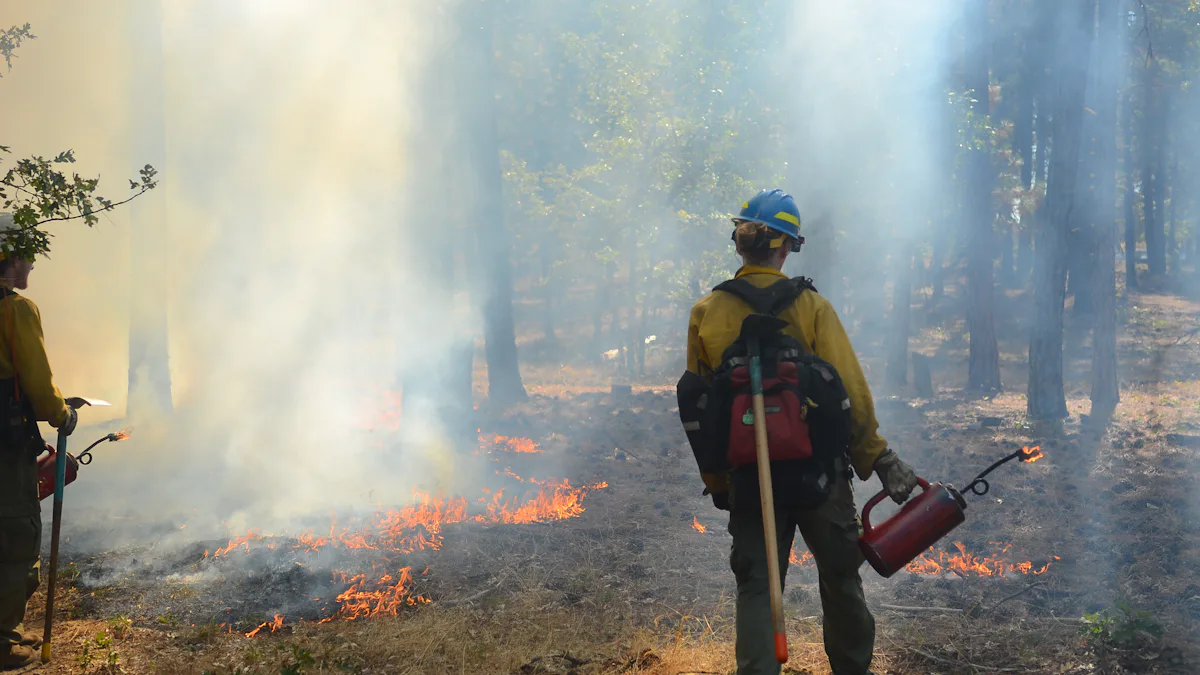
A forestry job order posted on the US Department of Labor's seasonal jobs site for the 2026–27 season in Oregon lists a base rate of $17.68 to $27.80 an hour, with overtime at $26.52 to $41.70. The duties: planting seedlings, thinning young stands, piling slash and clearing brush to reduce fire risk. That is what a real H-2B "wildland fire" job usually looks like.
Social media posts promise foreigners $72,000 a year as American firefighters. The reality is different, but not bad. You will not ride a city fire engine on an H-2B visa. You can get a legal seasonal job doing forestry and fuels reduction work in the western and southern states, and with overtime a strong season can out-earn most office jobs back home.
This guide explains which jobs are actually open to foreign workers, what they pay, what the employer must pay for, and how to apply without getting scammed.
In this guide
- H-2B Forestry and Fire Jobs at a Glance
- Firefighter vs Forestry Worker: What H-2B Really Covers
- How Much H-2B Forestry and Fire Work Pays
- What Your Employer Must Pay For
- Who Qualifies
- The H-2B Cap and Timing
- How to Apply Step by Step
- Documents Checklist
- Life on a Forestry Crew
- Common Mistakes and Refusal Reasons
- Frequently Asked Questions
- Before You Apply
H-2B Forestry and Fire Jobs at a Glance
| Item | Details |
|---|---|
| Who it's for | Fit adults willing to do hard outdoor seasonal work; experience with chainsaws, tree planting or farm work helps |
| Typical pay | About $18–$28 an hour base in 2026 job orders, time-and-a-half overtime in most jobs |
| National benchmark | BLS median for forest and conservation workers: $43,680 a year ($21.00/hour), May 2025 |
| Visa | H-2B temporary non-agricultural worker, employer-sponsored |
| Season length | Usually 6–10 months, often autumn to summer for planting and thinning |
| Annual cap | 66,000 H-2B visas per fiscal year, split into two halves of 33,000 |
| Cost to you | Passport and personal costs; the employer must cover recruitment, visa fees and travel under the rules |
| Path to green card | None built in; H-2B is temporary |
| Official source | USCIS H-2B page |
Firefighter vs Forestry Worker: What H-2B Really Covers
This is the part most job ads skip, so let's be blunt.
Jobs you cannot get on H-2B
- Municipal (city) firefighters. Career fire departments hire through civil service exams and almost always require citizenship or permanent residence. They do not sponsor temporary visas.
- Federal wildland firefighters. Hotshot crews, smokejumpers and engine crews with the US Forest Service, Bureau of Land Management and National Park Service are federal jobs. Federal hiring generally requires US citizenship.
- State fire agencies. State forestry and fire departments set their own rules, but they hire people who already have permanent permission to work in the US.
Jobs you can get on H-2B
H-2B is for non-agricultural work that is seasonal, peak-load or one-time. Forestry contractors use it heavily. The jobs fall into a few groups:
- Reforestation: hand-planting seedlings after logging or wildfires, often thousands of trees per day, sometimes paid by piece rate if that beats the hourly wage.
- Thinning and fuels reduction: cutting small trees and brush with chainsaws and hand tools, piling it, and sometimes burning the piles under supervision. This is the "fire prevention" work in many job ads.
- Brush clearing and firebreaks: clearing vegetation along roads, power lines and property edges.
- Fire support on private contracts: some contractors that hold fire suppression or mop-up contracts include fire-line support in their job orders. These roles need specific training, and the job order must say so.
The occupation on most of these job orders is "Forest and Conservation Workers." If an ad says "firefighter, H-2B, $72,000" and gives no Labor Department case number, treat it as a red flag.
How Much H-2B Forestry and Fire Work Pays
The wage floor
H-2B employers must pay at least the highest of the prevailing wage for that job in that area, the federal minimum wage, or the state or local minimum wage. The Labor Department sets the prevailing wage from the Occupational Employment and Wage Statistics survey, so it moves each year, usually on July 1.
What BLS data shows
| Occupation | BLS median pay (May 2025) | Notes |
|---|---|---|
| Forest and conservation workers | $43,680/year ($21.00/hour) | Main H-2B forestry category |
| Fallers | $52,100/year | Experienced chainsaw tree fellers |
| Logging equipment operators | $49,740/year | Usually needs machine experience |
| Firefighters (all types) | $59,280/year ($28.50/hour) | Mostly municipal and federal jobs, not H-2B |
Notice the firefighter median. That is where the "$60,000 firefighter" claims come from, but those are mostly city and federal jobs that require citizenship.
What a real season can add up to
Annual medians assume a full year of work. H-2B is a season. Here is a realistic example using rates from 2026 Oregon job orders:
| Scenario | Weekly earnings | 36-week season |
|---|---|---|
| $21/hour, 40 hours, no overtime | $840 | About $30,000 |
| $21/hour, 40 hours plus 10 overtime hours at $31.50 | $1,155 | About $41,600 |
| $25/hour, 40 hours plus 15 overtime hours at $37.50 | $1,563 | About $56,000 |
All figures are before tax. Overtime is not guaranteed. Rain, snow, contract gaps and fire restrictions can cut hours. Some small forestry employers can also be exempt from federal overtime rules, so check the overtime line on the job order. A season above $55,000 is possible for an experienced worker on a busy crew, but $30,000 to $45,000 is a more honest expectation for a first season.
What you will spend
Unless the job order includes housing, you pay rent, and you buy your own food. Rural rents are lower than in cities, but crews move between sites and motel bills add up. Federal and state income tax, Social Security and Medicare are withheld from your pay.
What Your Employer Must Pay For
H-2B rules put most of the costs of bringing you to the US on the employer. Under Labor Department regulations:
- Visa and related fees: the employer must pay or reimburse your visa application fee and related costs in your first workweek. Your passport is your own cost.
- Inbound travel and daily meals on the way: the employer must reimburse your travel from home to the job once you complete 50% of the work period, and federal minimum wage law may require earlier repayment if those costs pull your first week's pay below the minimum wage.
- Return travel: paid by the employer if you finish the contract or are dismissed early.
- Tools and safety gear: required tools, equipment and supplies must be provided at no cost to you.
- No recruitment fees: you cannot be charged for placement, and recruiters working for the employer cannot charge you either.
The full list is on the Labor Department's H-2B worker protections page.
Who Qualifies
There is no degree requirement. What employers want:
- Physical fitness. Planting crews climb steep slopes all day carrying heavy bags of seedlings. Fire support crews often require the federal "arduous" work capacity test: walking 3 miles with a 45-pound pack in 45 minutes.
- Chainsaw or tool skills. Thinning and falling jobs often ask for 3 to 12 months of experience.
- Some English. You need to follow safety briefings. Crew leaders on many forestry crews also speak Spanish.
- A clean record. Criminal history and past US immigration violations can block the visa.
- For fire-line work: basic wildland fire training (often courses known as S-130, S-190 and L-180) and an incident qualification card. Good employers train you after hiring and do not charge you for it.
Since January 2025, US regulations no longer limit H-2B to nationals of a list of designated countries. However, a presidential proclamation in force since January 1, 2026 bars all visas for nationals of several countries, including Haiti, Sierra Leone, Chad and Somalia. Check the State Department's visa restrictions notice for the current list.
The H-2B Cap and Timing
Congress caps H-2B at 66,000 visas a year: 33,000 for jobs starting October to March and 33,000 for April to September. Demand is far higher. USCIS announced in September 2026 that the cap for the first half of fiscal year 2027 was already full.
Two things help forestry workers:
- Returning workers. For fiscal year 2026, the government released up to 64,716 extra supplemental visas, and much of that allocation was reserved for workers who held H-2B status in one of the previous three years. Whether a similar release happens for 2027 is not yet known.
- Cap-exempt extensions. If you are already in the US in H-2B status, a petition to extend your stay or change employers does not count against the cap.
So your first season is the hardest to get. Do it well, and the same employer is likely to request you again.
How to Apply Step by Step
- Search official job orders. Go to SeasonalJobs.dol.gov, filter by H-2B and search terms like "forest," "tree planting" or "thinning." Each listing has a case number, wage, dates, location and employer contact.
- Contact the employer directly. Many forestry contractors hire through crew leaders and returning workers' referrals. Ask whether the job order is current and how they recruit abroad.
- Get a written job offer. It should match the job order: wage, hours, location, dates, housing, and overtime.
- The employer files the paperwork. First a temporary labor certification with the Labor Department, then Form I-129 with USCIS. You do not file anything yourself at this stage.
- Complete the DS-160. Once the petition is approved, fill in the online visa form and book an interview at your nearest US embassy or consulate.
- Attend the interview. Bring your passport, approval notice details, job offer and proof of experience. The visa fee for petition-based visas is $205; the employer must reimburse it.
- Travel and start work. You can enter the US up to 10 days before the start date on your petition.
Documents Checklist
- Valid passport (at least six months beyond your planned stay)
- Signed job offer or contract matching the DOL job order
- DS-160 confirmation page
- Interview appointment letter and visa fee receipt
- Petition receipt or approval number from the employer
- Reference letters showing forestry, farm, chainsaw or labour experience
- Any training certificates (chainsaw safety, first aid, fire courses)
Life on a Forestry Crew
Expect early starts, long drives to remote units, and weather from freezing Oregon rain to Southern summer heat. Crews often share rented houses or motels and move every few weeks. Phone signal can disappear for days.
H-2B status is tied to your employer. You cannot freelance or take a second job with another company unless a new employer files a petition for you. If your job ends early, recent rules give you a grace period of up to 60 days to find a new sponsor or leave. You can stay in H-2B status for a maximum of three years in a row, then you must spend at least 60 days outside the US before returning.
Common Mistakes and Refusal Reasons
- Paying a "recruiter" for a job. This is the most common way people lose money. See our guide to spotting fake job offers and visa scams.
- Applying for jobs that don't exist. If you can't find the case number on the DOL site, assume it is fake.
- Overstating experience. Consular officers may ask you to describe chainsaw work or tree planting. Be ready to talk about it honestly.
- Weak ties at the interview. H-2B is temporary, so the officer needs to believe you will go home when the season ends.
- Past overstays or false documents. These lead to refusals and can bar you for years.
Frequently Asked Questions
Can I become a firefighter in the USA with an H-2B visa?
Not a city or federal firefighter. Those jobs require citizenship or permanent residence. H-2B covers seasonal forestry and fuels reduction work, and some private contractors include fire support duties when the job order says so.
How much can I realistically earn in one season?
Most 2026 forestry job orders pay roughly $18 to $28 an hour. A first season of 30 to 36 weeks typically brings $30,000 to $45,000 before tax, and experienced workers with steady overtime can earn more.
Do I need experience to get hired?
Tree planting and brush clearing jobs often accept beginners who are fit and willing. Chainsaw and falling jobs usually ask for several months of experience, and fire support roles require training that a good employer provides.
Who pays for my flight to the US?
The employer must reimburse your inbound travel and daily travel meals once you complete half of the work period, and earlier if minimum wage law requires it. They must also pay your return trip if you finish the job or are let go early.
Can H-2B forestry work lead to a green card?
Not directly. H-2B is temporary, and seasonal work does not qualify for most green card routes. Some workers later move to employer-sponsored permanent jobs through EB-3 sponsorship, but that is a separate, long process.
Can I bring my family?
Your spouse and unmarried children under 21 can apply for H-4 visas, but they cannot work in the US. Because crews move often and housing is shared, most workers come alone.
Before You Apply
- Search SeasonalJobs.dol.gov for active forestry job orders and note the case numbers, wages and dates.
- Collect proof of any outdoor, farm, chainsaw or construction work you have done, with contact details for references.
- Start walking with a loaded backpack now. Fitness tests are real, and slopes are steep.
- Compare other seasonal options too, such as H-2B construction and landscaping jobs and H-2A farm jobs, which have no annual cap.
Disclaimer: This guide is general information, not legal or immigration advice. Fees, quotas and requirements change often, so confirm every detail on the official government website before you apply or pay anyone. See our editorial policy.